i like to force myself out of my comfort zone and do something new.
— noone
Pikachu uses confusion. It’s super effective!
I don’t know why I suddenly had the urge to do this, to freewrite without any constraints, to write according to my own will. Maybe it is because I have always been told that I type very fast and should make good use of that.
I also think a lot, even though thinking isn’t really useful or productive. Thinking does not make money, thinking does not contribute to the GDP, but I like indulging in hypotheses and fantasies.
I also suck at speaking verbally to other people, not necessarily speaking in general, because speaking can also be nonverbal and I can also speak to myself. I am talented at speaking to myself when I have the time, but when I speak to myself my poor memory kicks in and counteracts my thoughts. What else can I do but note down what is spoken between me and myself if I do not wish for these fleeting moments to escape from me.
BREAN. War is show business, that’s why we’re here.
(Levinson)
In the 1997 comedy film Wag the Dog, spin doctor Conrad ‘Connie’ Brean is enlisted by the president to create a nationwide story to divert the American public’s attention from his recent sex scandal. Brean decides that fabricating a war on Albanian terrorists would be the best distraction, and so he seeks the help of renowned Hollywood director Stanley Motss. The film remains a topic of discussion 20 years later, not only because it was nominated for Best Adapted Screenplay at the 70th Academy Awards, but also because it highlights the undeniable relationship between counter-terrorism propaganda and Hollywood show business. In effect, the satirical film points towards a more serious political reality: the existence of a Washington, D.C. and Hollywood symbiosis. The fact that artworks from Hollywood are being repurposed to suit the interests of politicians in D.C. begs the question of whether art is, to a certain extent, propaganda.
An abundance of literature on this symbiotic relationship, from essays by authors like George Orwell to speeches by W. E. B. Du Bois, focuses solely on examining art from the perspective of literature and fine arts. This essay, however, will take a different angle by exploring the relationship through a filmmaker’s lens, under the political context of terrorism. In advancing the argument that “all art is propaganda,” this paper will concentrate on Hollywood films and TV as an “art” form and Washington D. C.’s fearmongering portrayal of terrorism as a type of “propaganda.”
There exists a palpable connection between the state and Hollywood, where filmmakers make their movies resemble propaganda both consciously and unconsciously. But all art is, to some extent, propaganda. Thus, there is no point in differentiating whether films are propaganda or not, and whether such propaganda is justifiable or not. Instead, one should distinguish between harmful and innocuous types of propaganda, such that we can avoid being manipulated.
Hollywood terrorism films do seem to resemble propaganda, as their sensationalizing and reductive manner of portraying terrorism reflects an ulterior political motive. A reason for this resemblance, American economist Tyler Cowen would argue, is that the display of sensationalized content by terrorists in actual terrorist attacks acts as inspiration for Hollywood producers. In Terrorism as Theater, Cowen posits that terrorism has its own “production function” where “current terrorists may be trying to create aesthetic spectacles to maintain terrorist ‘firms’ as a going concern” (233). He defines these “spectacles” as “an investment in focality” for the terrorists which is further reinforced when “the media disseminate[s] the relevant stories and images and the terrorists revel[s] in the free advertising they receive for their deeds and goal” (Cowen 234, 235). The spectacles that Cowen refers to could be, for instance, the live streaming of executions by ISIS or the 9/11 suicide attacks. In some sense, terrorists are taking up the role of an entertainer by using entertainment strategies, such that they remain at the centre of attention worldwide. Since these publicity stunts are often the only way filmmakers receive information on what terrorist attacks look like, they subconsciously sensationalize the content in a similar manner when depicting the subject matter in movies.
However, not only do Hollywood producers unconsciously or subconsciously produce films in a propagandistic manner, they in fact deliberately oversimplify and sensationalize terrorism issues for economic incentives. Movie critics in the past few decades have repeatedly condemned films on terrorism for providing wildly inaccurate depictions of actual events in order to boost ticket sales. For example, the New York Times recently reviewed Hotel Mumbai, a 2019 action thriller film based on the 2008 Mumbai terrorist attacks, and Déjà Vu, a 2006 sci-fi action film about a law enforcement officer travelling back in time to prevent a terrorist attack. In the former, film critic Ben Kenigsberg states that Hotel “reduces the randomness of real-life bloodshed to the slick thrills of a popcorn movie”; while in the latter, the critic shuns Déjà’s “divorce from the here and the now of contemporary politics, policy and people” and the vulgarity that “exist[s] purely for an evening’s entertainment, for loud noises and flashy pictures, big stars and fast action, violence and yet more violence” (Kenigsberg; “Movies”). The two main reasons for which the films have been criticized, their reductive and sensationalized manner of portraying terrorist attacks, underline precisely their resemblance to propaganda.
The first critique among the reviews is the films’ reductive tendencies: producers lack interest in portraying the true details of the situation, and, frankly, also lack the knowledge to do so accurately. The political, social and historical context tends to be removed in these films for economic and, ironically, political purposes. Tony Shaw, a professor of Contemporary History, dissects the reason behind this decontextualization, claiming that a “majority of films over time and space have presented perspectives of terrorism that are aligned with the interests and priorities of the prevailing state, social and economic orders in which they are institutionally and ideologically located” (284). These filmmakers are, hence, incentivized to depoliticize the content of their films by focusing on human interest narratives and showing the “perspective of individuals rather than wider societal and political conditions” (Shaw 285). In order to protect themselves from political reproach, filmmakers inherently form a political bias in their depictions of terrorism that favors the majority opinion. This allows them to avoid moviegoers criticizing and, more importantly, boycotting their films, which would effectively act as an economic sanction. But this trend also leads to films shying away from having a didactic, informative purpose, while inclining towards a form of pure entertainment value that is not disruptive to the prevailing order.
Another characteristic that critics spotted in the films was the sensationalizing portrayal of vulgarity. French scholar Étienne Augé attributes this trend to the profit-making mentality of filmmakers:
“Violence is a key issue in the Hollywood industry. Although it is opposed by many associations in the United States, violence sells and attracts audiences to Hollywood movies […] In 2002, out of the 132 films which earned more than 200 million dollars worldwide, 49 were rated R, 23 PG, 49 PG-13 against 11G”
(Augé 149)
In this profit-seeking show business industry, rational filmmakers capitalize on whatever attracts more moviegoers to watch their films. Violence sells and so they exaggerate the violence in films to garner more ticket sales. Furthermore, the violence that is hyperbolized is justified as Hollywood considers this form of violence to be “positive violence”: “Violence is acceptable, as long as it is directed against forces of evil” (Augé 150). So, not only is there an economic stimulus for producers to exaggerate the violence, there is even a moral justification to do so since it would not stir controversy. Therefore, the entertainment industry seems to inherently provide political, economic and moral incentives for filmmakers to intentionally sensationalize and oversimplify issues of terrorism in films. But looking beyond moral and economic incentives, the relationship between Hollywood and politics is much stronger than a merely indirect one: films of the terrorism genre do not merely resemble propaganda; they are inevitably linked to propaganda.
Governmental agencies and members of the film industry have collectively blurred the boundaries between Hollywood and D.C., between art and propaganda. In 2004, David L. Robb delved into hitherto untrodden territory in his book Operation Hollywood, where the Pentagon’s acts of monitoring and censoring Hollywood motion pictures were disclosed to the public. The revelations were ground-breaking since until that point, “most Americans [were] unaware that the US military routinely reviews scripts and that the Pentagon compels changes to convey the government’s message… This work is done by a team of military reviewers ‘embedded’ in Hollywood” (Turley 17). Despite Pentagon officials’ repeated denials of spreading propaganda or practicing censorship, Jonathan Turley declares in the foreword of Operation Hollywood that their use of “threats or rewards to shape films to advance a particular sanitized view” essentially constitutes exactly what they condemn (16). The Pentagon has heavily invested itself into the Hollywood show business, such that it will be able to control the public perception of terrorism.[1] So, Hollywood filmmakers are not simply willingly and intentionally misrepresenting terrorism, they are in fact compelled to do so by governmental powers. The immense effort by the Pentagon to shape Hollywood’s rhetoric on terrorism demonstrates how vital the entertainment industry is in affecting the social and political views of Americans. On issues of terrorism specifically, the relevant films act as one of the only visible sources of information on terrorism for the average person. People tend to base their beliefs heavily on these films, which is why Augé claims that Hollywood is, arguably, “the foremost educational institute on earth” (148). The fact that the US military is essentially controlling education about terrorism certainly raises a few eyebrows in terms of the integrity of American democracy.
Yet, the relationship between political powers and the film industry is not unidirectional and lopsided but rather reciprocal and collaborative; well-established members of the Hollywood industry participate in aiding politicians as well. Shaw demonstrates the contribution of Hollywood to Washington, as he observes that:
“White House had set up a group of directors and producers christened Hollywood 9/11 that would take the fight to the Islamist enemy. Simultaneously, the US Army created a Hollywood think-tank, whose membership included Die Hard’s co-creator Steven de Souza, tasked with predicting future terrorist scenarios. Over the following months and years, the American film industry turned out an extraordinary range of material exploiting, explaining and interpreting the latest Age of Terror”
(shaw 224, 225)
The seemingly independent fields of entertainment and politics intersect through the collaboration between politicians and Hollywood producers and directors. This relationship is mutually beneficial for both sides: politicians are able to put forward their political agenda through a form of soft power, while producers, in exchange, are given “advice, permission to use locations, and equipment such as aircraft carriers” by the CIA or financial backing by the Pentagon (Alford 2017). In fact, the Pentagon has backed more than 1,100 titles on television, including select episodes of famous series like 24 and Homeland, which combine for 28 Primetime Emmy Awards and 7 Golden Globe Awards (Krug). 24 is also known for being the longest-running American counterterrorism-themed drama ever. The quid pro quo between the two parties enables each to exercise sizeable power in their counterparts’ respective fields. The extension of governmental power into the field of Hollywood to shape the cinematographic discourse on terrorism is not forceful in any sense. The government is simply acting upon a cordial invitation from Hollywood producers and directors, such that they reap the economic benefits. Filmmakers would be especially incentivized to subscribe to ideas imposed by governmental powers in exchange for economic benefits given the exorbitant cost to produce a feature film, ranging from $70 to $90 million on average, wherein production costs take up around $34 million (Parlay Studios).
American action drama TV show 24 starring Kiefer Sutherland with 9 seasons from 2001 to 2010
Scholars like Robb and Shaw hold a common belief that Hollywood films resemble propaganda in the sense that a Washington influence exists behind these films, but they refrain from expressing their opinion on whether this interdependence is ethical or not. Intuitively, this interdependent relationship seems to undermine the American democratic system and comes off as unethical, if not corrupt. Turley stipulates that “in the very least, [military funding of television or films] is a misuse of public funds. At worst, it is a new variation on censorship, crafted to operate in the shadow of the First Amendment” (Turley 21). He raises the controversial issue of allowing politics and Hollywood to intertwine comfortably without anyone being able to hold either party accountable. French specialist in American strategy Jean-Michel Valantin further expounds on Turley’s argument in regards to the lack of public accountability: he observes that the “American society, but also worldwide public opinion, has become accustomed to seeing the American strategic system and the country’s film industry engage in constant communication” (Valantin ix). Nonetheless, Valantin and Turley would both agree that giving Hollywood and government officials free rein to collude is morally unjust and would be an injustice to the American society. Thus, the distorted characterization of terrorism by Hollywood seems to signify a fundamentally unethical politicization.
However, on a deeper level, the propagandistic portrayal of terrorism in Hollywood films might simply demonstrate that in the field of art, especially in the cinema industry, it is impossible to separate a piece of artwork from its political and social context. In 1925, Pulitzer Prize winner Upton Sinclair noted the inextricable relationship between art and propaganda. He argues that art is when an artist represents his own version of reality “for the purpose of modifying other personalities, inciting them to changes in feeling, belief and action” (Sinclair 10). This definition of art bears an eerie resemblance to that of propaganda, work “produced in the belief that it will evoke an attitude in its viewers that will prompt action” (Kuhn, Westwell).
Art critic Ben Davis further solidifies this symbiosis by stipulating that “because art is part of society, and because no single profession has a monopoly on creative expression, the values given to art within the sphere of the contemporary visual arts will also be determined in relation to how ‘creativity’ is manifested in other spheres of contemporary society” (Davis). Davis fundamentally believes that the evaluation of art can only be based on the sociopolitical context of a certain time, and at the same time, art also inevitably has implications on politics and society. Davis’ claim can be distinctly contrasted with the idea of pure aestheticism promoted by abstract expressionists in the 20th century like Jackson Pollock and Mark Rothko. But in 1995, well after death of these artists, former CIA case officer Donald Jameson admitted publicly that the CIA funded these artists during the propaganda war with the Soviet Union “as proof of the creativity, the intellectual freedom, and the cultural power of the US” (Saunders). Even abstract expressionists like Pollock and Rothko eventually had their artworks mixed up with politics as they were adopted for propaganda purposes during the Cold War. This demonstrates how hard it is to differentiate between art and propaganda, meaning an attempt to distinguish the non-propagandistic and propagandistic elements of artworks would be, simply put, implausible.
Thus, since it is almost impossible to make art that is not propagandistic in any aspect, the previous discussion of whether Hollywood films are propaganda or whether the propagandistic motives behind these films are ethical is no longer valid. This is because both these discussions presuppose the notion that filmmakers have a choice between shaping their films as propaganda or to not do so. Rather, it is essential to understand what the propaganda is for. In this case, for instance, the harmful aspects of propagandistic terrorism movies can be distinguished from the harmless aspects found in other genres like horror and thriller movies: the former poses an unavoidable real-life danger that is unobserved among the effects of the latter. A Vox study shows that the sensationalistic coverage of terrorism in mass media has caused “Americans to overestimate the danger posed by terrorism”, which leads us to “overreact, pursue unhelpful security measures, and rally behind politicians who embrace over-the-top responses to terrorism” (Maza). This means that the approach taken by the entertainment industry in depicting terrorism also plays a role in feeding into the American perception of terrorism.
Terrorism propaganda by politicians does not aim to convince other nations of American superiority, as it did during the Cold War era, but instead is targeted at the American public. This fearmongering directed at the US populace is detrimental to them and should be thwarted. Stephen H. Unger, Professor Emeritus at Columbia University, notes that “maybe the concern about terrorism has been greatly exaggerated. If so, this would not be the first time in our history that fear of sinister outside forces has been inflated to justify assaults on civil liberties. Recall the Eighteenth-Century Alien and Sedition Laws, the post-World War I Palmer raids and mass deportations, and the McCarthy era hysteria” (3). The past has proven that political and governmental powers are capable of scheming and collaborating with other agencies to produce unsubstantiated fear among Americans, in hopes of swaying public political opinion in their favor. These historical cases bear striking resemblance to the current situation of terrorism as portrayed by Washington and Hollywood. A culture of unjustified fear is being instilled among Americans, leading to an inaccurate bias that will affect their political decisions. Misinformed political decisions of this sort would give government leeway to act however they would like under the guise of “terrorism”. Hence, if people continue to have a misconception of the reality of terrorism, it could lead to counterproductive political actions, such as racial, religious and cultural discrimination, that stem from an overestimation of danger.
We must thus re-evaluate the notion of propaganda and understand that its effect on art could be both negative and positive. Especially since Hollywood television deliberately and naturally obscure the difference between the two, as Professor Greg Rabidoux observes that “the intersection of politics and Hollywood, both on and off-screen […] was once unthinkable [but] seems now to be commonplace” (xi). Politics simply seem to be so well-blended into Hollywood show business that the public is rarely on the qui vive for government meddling in cinematic portrayals of terrorism. Even if all art is propaganda to a certain extent, there are some occasions where it poses more harm than good. Recognizing the malleability of truth in Hollywood terrorism films is the first step to prevent being manipulated when making political choices.
In conclusion, Winifred Ames, the president’s PR-advisor in the movie Wag the Dog, succinctly summarizes the political repercussions of underestimating the danger of Hollywood terrorism propaganda:
MOTSS. What did television ever do to you?
AMES. It destroyed the electoral process!
(Levinson)
[1] Although this discussion is limited to the Pentagon, but Hollywood’s collaboration extends to other government agencies as well, such as the CIA, NSA, FBI, the White House and the Department of Defense.
Although the story of David and Goliath originates from Christian teachings, it is currently well known by people from all over the world, regardless of religion, race and culture. The modern usage of this story generally applies to uplifting scenarios where an underdog defeats a strong adversary. Yet, despite the physical and contextual similarities, this was not the case in Ramón Espinosa’s 2011 image. This image captures the moment a Haitian protester hurled a block of cement at a United Nations (UN) peacekeeping vehicle with two peacekeepers inside. In Espinosa’s photo, the foreground is dominated by the UN representatives who sit in a Mitsubishi Pajero SUV, while the out-of-focus protester, who appears to be one-sixth of the vehicle’s size, is relegated to a mere background. Proportionally, the vehicle takes up around 80 percent of the photo, and in contrast, the protester only takes up less than 10 percent. The protester is in a fleeing stance, ready to escape from the UN vehicle, while the peacekeepers seem to be driving away from the chaotic protest scene with all the doors locked. Moreover, the block of cement thrown by the protester has bounced off the exterior roof of the SUV after making contact. But despite absorbing the brunt of the impact, the vehicle appears to remain undented and undamaged and its pristine white surface remains barely soiled or tainted. In this case, however, the underdog protesters, unlike David, were eventually far from being able to claim victory over the overbearing UN.
A man throws a block of cement at a UN vehicle in Haiti, Sept. 8, 2011, during a demonstration over allegations of Uruguayan peacekeepers sexually abusing a young Haitian man. . AP Photo/Ramon Espinosa
In 2011, Espinosa, a photographer for the Associated Press, covered the Haitian demonstrations over allegations of sexual abuse by UN peacekeepers. The demonstrations were organized to protest the consistent immunity enjoyed by many peacekeepers in spite of their sexual abuse and rape cases, where they had abused their powerful positions to commit oppressive and unethical actions. The specific photo in question acts as more than just an image in of itself, but also as a symbolic representation of the UN peacekeeping situation. On the surface, the photo indicates a simultaneous expression of disapproval, revulsion and fear by the cement-throwing protester. Upon closer inspection, not only does it show an inherent inequality between the peacekeepers and the local Haitians in the situation, it also reflects the fundamental hypocrisy in the UN’s mission of maintaining peace and human rights.
It is intuitively reasonable to question my prior categorization of the UN as an overbearing adversary like Goliath, and to wonder why the keepers of peace would stand in opposition with the population they were designated to protect. Yet, underlying this intuition is a more complex predicament, in which we are conditioned to assume that whatever the UN does is contributing to the greater good. It is unnatural to criticize the UN or inquire extensively into its missions, since we are rarely informed about the hypocrisies and controversies hidden behind the façade of the UN. However, through the Haitian protester image, Espinosa presents a photographic criticism of the UN’s definition of human rights, which does not, in fact, act in the interest of safeguarding actual human rights. Here, the UN is, in effect, an entity that has given itself liberties in being able to get away with human rights violations thanks to its convincing pretense of advocating for those rights. The fact that this very entity entrusted to protect a population is in the process of silencing them signifies the development of a morally deplorable situation that deserves to be scrutinized and condemned.
The UN preaches a set of human rights de jure, but practices another set de facto. To understand this entity’s contradiction in definitions, it is necessary to first turn to the Universal Declaration of Human Rights (UDHR), the fundamental document illustrating and formulating UN’s idea of “human rights.” These rights are generalized and conceptualized in the foreword: the UN states, for example, that it “set[s] out universal human rights for all people in an individual context” (UN General Assembly Foreword). In using a seemingly inclusive tone and language, the UN portrays an image of catering to “all people” individually and empathizing with all human beings. Moreover, the UN further vows to recognize “inherent dignity and […] equal and inalienable rights of all members of the human family” as the “foundation of freedom, justice and peace in the world” (UN General Assembly Preamble). The diction used in this statement, like “freedom,” “dignity,” and “peace,” highlights moral values that are intuitively pleasant, convincing readers to view the UN as a benevolent peacemaker. So, the UDHR reflects two essential characteristics of the version of human rights constructed by the UN: it is human-centered and acts for a good cause.
Although the UN General Assembly has constructed a seemingly universal idea of “human rights,” author Rebecca Solnit would regard it from a distance and tend to have reservations about the constraints set forth in the UDHR. In A Short History of Silence, Solnit stresses the importance of breaking existing contradictory social rules and constructs through the use of words. “Speech, words, voice sometimes change things when they bring about inclusion, recognition, the rehumanization that undoes dehumanization” (Solnit 20). Solnit here emphasizes the importance of speaking up and breaking the silence in the face of things that might be “dehumanizing,” especially when doing so can “bring about justice and liberty” (20). The “dehumanizing” structure that is explored specifically in Silence is the misogyny faced by women when they are silenced under a patriarchal context. Through exploring the historical development of this notion, Solnit aims to empower women to speak up and undo this unjust form of silencing. In order to counteract this oppression, she highlights the need to recognize the institutionalized “dehumanization” before one proceeds to the “rehumanization” aspect. Applying this principle to the UDHR, Solnit would urge us to take the UN’s “human rights” definition with a proverbial grain of salt, and to address whether we have been conditioned to perceive it in an unjust and incorrect manner. Indeed, the UN appears as an altruistic and innocuous peacemaker in its mission to safeguard human rights on paper, but acting upon Solnit’s guidelines, we are prompted to question whether this written definition translates to its practical work. Maintaining a level of skepticism towards the UN is especially pertinent in light of the Haitian demonstrations, and thus, a further examination of Espinosa’s image yields a better perspective of how the UN conducts its practical peacekeeping missions.
Unfortunately, according to the image, the UN fails to appear consistent in upholding a common standard of human rights in practice, due to an institutional lack of accountability for the unethical actions of peacekeepers. Staging his photograph from the perspective of the perpetrators, Espinosa presents them as if they are ready to easily drive off from the protester’s vain attempts to attack the vehicle, without having to confront his calls and demands. Not only are the peacekeepers in the scene securely protected by the fortified van, they are also sheltered by the label of the UN institution amidst the chaotic demonstrations. During such tumultuous situations, peacekeepers are granted physical protection as they are able to remain unharmed and not be held accountable. They also enjoy an institutional protection from the UN bureaucracy because the only means victims and witnesses have of speaking up against these oppressions would be to complain to the UN, which is ironically the perpetrator of those oppressions. Hence, victims of oppression, in effect, lack access to a legitimate channel, both on the physical and the institutional level, to complain about these human rights violations.
Yet, the UDHR states that “everyone has the right to an effective remedy by the competent national tribunals for acts violating the fundamental rights granted him by the constitution or by law” (UN General Assembly 10). This means, by definition, that abused local Haitians must be granted recourse to file complaints against UN peacekeepers. In reality, however, this contributes yet again to UN’s construction of a façade that seems to advocate for human rights while failing to substantively protect them. The depth of field and proportions in Espinosa’s image reflect the inherent imbalance in attention and recognition given to the violators and victims of human rights. The power is asymmetrically distributed to the peacekeepers, who are able to easily elude the consequences of unethical actions without being held accountable and are entitled to protection from the UN bureaucracy. The peacekeepers’ facial features are blurred out and indistinguishable behind the tinted windows of the vehicle, forming a stark contrast with those of the protester, which are clear and unobstructed from view. This further demonstrates that even if the victims decided to navigate through the bureaucratic process and hold the perpetrators accountable, they would likely fail to identify these UN representatives, whose identities are well sheltered. These peacekeepers are given the power to act however they want under the guise of peacekeeping on behalf of the UN. The victims, on the other hand, are only granted the power to remain silent.
Under such atrocious circumstances, victims are forced to resort to physical violence as a form of protest against oppression and a final act of desperation, albeit in vain. Solnit discusses similar scenarios where stakeholders have had a silence “imposed” on them, akin to that of the Haitian protesters (17). The victims have no method of complaining and are simply forced to “scream in vain” in the “absence of listeners” (Solnit 40, 41). When these methods are of no avail and “the mouth may not speak,” the victims turn to physical testimonies, where “the body sometimes reveals” (Solnit 39). The act of throwing a cement block does not do much substantial damage to the peacekeepers, but it is the victim’s last resort for making a complaint, for stating their disapproval and for breaking their silence. Building on Solnit’s idea of “imposed silence,” Khatchadourian extends the discussion to the possible consequences of a lack of recognition of unethical actions in the long term. In Khatchadourian’s Remembering the Armenian Genocide, he examines how the Turkish state still “denies that a systematic annihilation ever occurred” apropos the Armenian Genocide, which leads to a “collective trauma […] compounded by the lack of official recognition and reconciliation” (Khatchadourian 1). Khatchadourian identifies the negative repercussions that could arise from silence in the context of unethical actions, such as mass murders and sexual abuse. Not only are these repercussions felt immediately afterwards, but they also add on to a long-lasting trauma that lead to institutional problems. Like a state that refuses to acknowledge genocides, the UN similarly refuses to acknowledge the unethical actions carried out by its peacekeepers, which seems ironically to be exactly what it condemns as a breach of human rights in the UDHR and other explicit treaties like the 1948 Genocide Convention.
This begs the question of whether the UN peacekeeping missions, which aim to safeguard human rights and serve the people, actually do so in reality. Although the UN proclaims theoretically that peacekeeping actions are done on behalf of the people and for the common good, the empirical facts seem to reflect the opposite. In practice, the UN’s definition of human rights is characterized by an inhumane silencing of victims and a deplorable refusal to recognize its own unethical actions. This urges us to remain skeptical when referring to the UN for a definition of human rights, and to formulate a definition proper to ourselves as human beings, that ensures the right of the protestors and not the occupants of the van.
The issue of UN’s hypocritical involvement in human rights might seem to be in the past, as we witness the UN’s complete withdrawal of all peacekeepers from Haiti this year. However, the detrimental repercussions of the past fifteen years of peacekeeping operations, awash with allegations of sexual abuse and rape cases, are still being felt nowadays. If the UN continuously fails to address the problem of accountability and hypocrisy, not only will these peacekeeping scandals be relegated to oblivion in the near future, but the international community will also be running a risk of facing new threats to global security. Unless we see the Davids in Haiti assert themselves over the monolithic Goliath one day, the battle against oppression will have to continue to be put under the spotlight until justice is served.
The half-French, half-Senegalese director Mati Diop drew sizable attention during the premiere of her first feature film “Atlantique” at Cannes in May. “Atlantique” tells the story of a young Senegalese girl, Ada (Mame Bineta Sane), who has an illicit relationship with construction worker Souleiman (Traore) even though she is arranged to marry an older wealthy man Omar (Babacar Sylla) in a few days. As Souleiman continues to get underpaid and mistreated at work, he decides to join his co-workers in a treacherous boat ride to flee Senegal for Spain, as he searches of a better life but leaves his unknowing lover Ada behind.
Soon enough, word on the street is that the migrants’ have failed in their attempts to reach Spain and have been engulfed by the Atlantic Ocean. However, the men soon find a way to return to their beloved ones in Dakar through possessing their girlfriends’ bodies after the sun sinks below the horizon. The realistic documentary-esque film suddenly takes a dramatic turn as fantastical elements, especially the zombie-like movements of the possessed women, are introduced.
Diop sets out to reinvent the stereotype of films that tackle the issue of mass migration. Rather than presenting a heart-wrenching display of the trials and tribulations faced by migrants, as Moussa Touré did in his brilliant 2012 film The Pirogue, Diop ventures into the complexities faced by the loved ones left behind by the migrants. In marrying realistic and fantastical elements, she blurs the boundaries between reality and imagination and forms a stark contrast between the rational and the irrational.
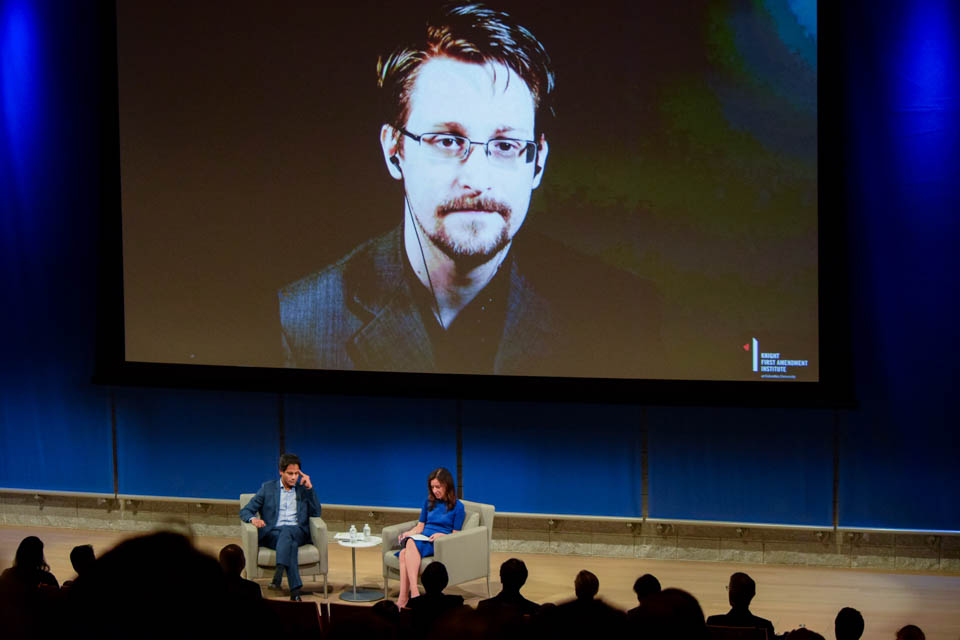
“The scandal isn’t how they are
breaking the law, the scandal is that they don’t have to break the law”, says
Snowden in one of his rare interviews with Youtuber Joe Rogan. He echoes this
in his October 29 talk at Columbia, as he underlines an important misconception
of equating lawfulness with rule of law. In comparison to his charge of
espionage, he points to NSA employees who commit petty cases of felony, such as
using NSA technology to track down romantic interests or personal enemies. But
these employees get away with the crimes as government agencies manipulate internal
rules and laws and turn a blind eye, eliminating the necessity to reveal any confidential
information to courts or the public. Snowden believes that in being an unlawful
whistleblower, he has revealed the flawed American system of rule of law and reminded
Americans of what a true rule of law should resemble: an ecosystem of institutions
that can hold each other accountable and maintain a true form of checks and balances.
The current ecosystem in America seems
to be inherently dysfunctional, as reflected by Snowden’s decision to rely on
journalists to disseminate his confidential information. His reliance on the
Fourth Estate to bring poetic justice to the American people suggests that he
regards journalism as the only remaining process of checks and balances in the
society that functions democratically. The reason these checks must be put into
place, he argues, is such that a neutral venue, free from tyranny by a single
institution, can be proposed to accommodate the evolving discussions on
definitions of ideas like human rights and cyber warfare.
This does not mean that he disagrees with the need and confidentiality within government agencies. As a matter of fact, Snowden agrees with the Obama administration, that initiated the pursuit for him, when they claim that a lack of secrecy would corrode a democracy. This draws parallels with similar ideas of protecting non-rivalrous ideas and innovations in the R&D field and the creative industry. In these areas, ideas receive patents or royalty that expire after an extensive period of time, whereby the people would be henceforth entitled to access the information and interpret the content at their disposition. Could this form of governmental regulation set an example for how the current intelligence system should be reformed?
Credits to Columbia Spectator
Edward Snowden arguably rose to
fame due to the timely coincidence of an unforeseen period of technological
growth and an essential political stimulus from the September 11 attacks. These
events brewed up the perfect storm for Bush Jr. to radically change the way government
intelligence agencies functioned: from a form where the individual precedes the
structure, to one where the structure precedes the individual. In the past, the
structure of surveillance missions was built around a selection of targeted
individuals; whereas nowadays, the structure is preemptively imposed upon all
individuals without any justification necessary. This radical manipulation in
government operations provided the scandalous material for Snowden’s groundbreaking
discovery.
Other factors that led to his
success, I would argue, are the exact phenomena he laments and condemns: the increase
in competitiveness and the loss of anonymity on the internet scene. He
regularly criticizes these two situations as he believes that they play a role
in the undermining of American democracy nowadays. Yet, it seems ironic that
without the capitalization of internet nowadays, he would not be able to make
money to sustain himself as he gives virtual lectures and talks to audiences
from all over the world. Moreover, he also has been able to profit from the lack
of anonymity since he has built an image worldwide as a symbol of free speech
and a beacon of light amidst the age of “fake news” based on the manipulation
of information.
Yet, by the end of the speech I still
left with several queries in mind. Firstly, Snowden mentioned how his status as
a private contractor, and not an employee, of the NSA led to a lack of
governmental protection and hence, the relentless retaliation from the
government. However, how big of a part did this exact dramatic “cat-and-mouse”
pursuit by the government play in heightening domestic and worldwide attention
to the issue that he was bringing up, in comparison to other whistleblowers? Also,
he brings up the point that passive cynicism is undesirable as that means accepting
the status quo for what it is, whereas active skepticism is necessary to
question these institutional failures. Yet, how does one find that delicate
balance between being skeptical but not cynical, since these two ideas are
easily confounded?
The talk ends
with a light laughter by the audience when Snowden displays statistics and
graphs that show the astonishing extent of mass surveillance by private companies
such as mobile network operators. Taking that one step further, is it not ironic
that we find knowledge of ourselves being spied on extensively humorous. Perhaps
this socially trained gut response by human beings to newly revealed evidence that
seem absurd and unimaginable on first sight is, in fact, a structural problem. Instead
of tackling the mind-boggling facts, we are conditioned to take a step back and
find the humor in it.
Joker is a movie seemingly about nihilism, but also a movie about nothing. Isn’t that a physical embodiment and testimony to the supposed message and idea of nihilism? Phillips seems to provide the audience with the perfect consummation of artistic intention and physical production.
Do
physical health conditions go so far as to becoming mental conditions? Was it
just a physical genetic inability to control his laughter, or was it, after
putting into a social context what laughter is supposed to convey as a form of
emotion, a mental condition of finding normal events ridiculous?
In Albert Camus’ “L’Étranger”, we see the same absurd existentialism: “[Meursault] finds a final happiness in his indifference towards the world and the lack of meaning he sees in everyone and everything.” The Joker is an embodiment of Meursault’s thoughts before passing away.
Is this left-wing, anarchist propaganda? A movie depicting a rise against capitalism, that draws parallels with Mr. Robot and V for Vendetta. If we assume that each murder was a premeditated artistic choice, then it is a statement against Wall Street perpetrators of elitism and unequal capitalism, against liars who are willing to forgo empathy and sympathy to fight for their own survival in a rat-race world, and finally against those who use words and language to mock others to sustain entertaining content (and hence, fame and power). These all form stark contrasts and comparison with the unabashed, Tarantinoesque excess of violence and bloodiness in Arthur Fleck’s murders, begging the question of whether we should regard verbal, emotional and psychological violence on the same level as physical violence. Does it mean that we, as socialized human beings, are hardwired to denounce blood and mourn for deaths, and that committing such a crime would absolve all actions that precede or succeed? In other words, is physical violence of this extent so shocking that we are forced to remove ourselves from the context and condemn such acts? The moment the Joker commits his first murder on the subway, all the prior pity the audience had for him evaporates in an instance, leaving him with the label of a cold-hearted, bloodthirsty killer. Yet, without going to that extent, would his sufferings ever be listened to or published or broken to the public? Even postmortem, these Wall Street victims would be commemorated with awe and love, while newspapers paint a rosy picture of a derailed sociopath brutally taking revenge on the elite of our nations. What if the tables were turned, would the protagonist and antagonist labels change? I doubt it, the institutionalized hierarchy would turn a blind eye to these crimes. Is the Joker morally deplorable for his killings? Absolutely, but he is simply not as unidimensional of a character as evil villains are portrayed to be in superhero movies, or even in real life.
Aesthetically
speaking, that’s where the movie receives a downgrade in my opinion. The extensive repetition of shots void of creative
intention puzzles the audience. The infamous Joker dance and his medically
conditioned laughter provide a shock effect to audience that go against the
norms of remorse and grief. It allows the audience to pause from the immediate
events and re-evaluate whether there is a set of inherently right moral values.
But the lack of progression and rationale behind the motif not only does not
contribute to the plot development, but even hinders the portrayal of a more
profound message. It gives off the impression that Todd Phillips has lost
control as a director over his narrative choices and simply opts for an easy
way out: reverting back to the well-known motif. Comparable to Midsommar,
Phillips fails to arrive at a concrete deliverable as he indulges in his quest
of an overly romanticized nihilistic vision.
A friend living abroad asked me
how the climate was like in Hong Kong currently. It was not an easy question
for me to answer.
To stick to a straightforward
and superficial answer, one could possibly describe it as chaotic, unsafe and
disrupting social stability.
But with appropriate government intervention and social infrastructure, I argue that this issue can be deal with properly or even prevented from happening. I do not mean to imply at all that this would be easy.
One must first understand that living in a special region like Hong Kong with such a peculiar climate means that typhoons of this magnitude are not uncommon. It might seem shocking initially as it disrupts the peaceful societal order, but it is in fact due to various environmental factors that led eventually to this phenomenon.
Yet, as such circumstances
arise, we might question ourselves: in light of this issue, to what extent is the
government responsible in combating and resolving such occurrences?
GOVERNMENTAL RESPONSIBILITY
The average member of the
society tends to have less meteorological knowledge and context about these
recent occurrences compared to other more informed and educated individuals in
the field of climatology. Hence, we put our faith in the hands of these elite
individuals to put forward relevant announcements, amendments and exceptions,
ensuring the safety of this nation’s individuals and the well-functioning of
the society.
Sometimes the decisions and
conclusions by these elites might not appease every single stakeholder of the
society, but with explanation and justification, healthy discussions could be
initiated. Since we confide in this governmental agency that is supported by
taxpayers’ money and consists of experts in the field, we expect a certain
amount of protection from these public servants. At the very least, something
acted upon and justified properly, even if it is not widely accepted, is
preferred to nothing being done.
Nonetheless, the level of
governmental intervention also fundamentally depends on the standards
previously agreed upon and announced by the governmental agency. In the case
where boundaries are broken or freedoms are infringed upon (for example, when
strong winds exceed 180 kilometers per hour) the agency would have the duty to
hoist necessary signals, advise precautionary measures and issue appropriate
protocols. This acts as a basic safeguard for the rights and freedom that any
citizen is promised.
And what happens when this agency
is unable to perform such duties? Well, thanks to the norms standardized by the
agency, the public can always revisit its publications and hold it accountable.
Thus, with the norms established, even if a catastrophe occurs in the society,
the public is still able to have a vague idea of what measures should be taken
accordingly and what rights they should be guaranteed. Therefore, dissent and
unrest could easily appear if this agency does not respect its self-binding
terms and conditions, leading to strikes and uncooperative movements in order
to protect their safety and self-interest.
RIGHT TO DISAGREE
Obviously, a temporary pause to
normal working conditions (self-imposed or imposed by the government) might be
easily disapproved of by big enterprises and organizations, since it means a
halt to their efficiency and production. But keep in mind, this is nothing but
a short-term hindrance, where necessary measures must be taken urgently to
counteract the imminent threat to their safety and rights. In the long run, if
these workers end up not being able to work properly and function efficiently
in the organization, it poses as an internal risk that could produce
unpredictable ramifications. So, is it worth the short-term stability and
consistency if that would necessarily translate to a long-term deterioration?
Accusations claiming that
people are simply just too lazy to work, and are unproductive members of
society might arise as well. Yet, this must be viewed from different angles, if
one works an office job in a well-insulated skyscraper from comfortable offices,
evidently there is nothing on the line, as to whether you would be impacted by
this disturbance. However, putting yourself in the shoes of someone from a more
grassroot level, perhaps a construction site worker, if you do not dissent
against such unaccommodating policies and restrictions, your life, your safety
and your rights might be at risk. Continuing ferry and tram services under such
dire circumstances due to the lack of proper governmental control could easily
lead to impending disasters, so would it make sense for these workers to
continue risking their lives despite the natural hazards around them? Those
sitting currently at their well-protected and fortified jobs, do you not
sympathize for the rest of the society and your fellow citizens from Hong Kong?
On that note, one might argue,
how is it ever possible for governmental parties to ensure that these workers
would be safer if they are authorized to go home and return to their most
familiar environment, as versus to if they kept their heads down and let the
future decide their destiny? Well, I must admit that is certainly impossible to
determine. It cannot be said that changes will necessarily ensue a better
outcome. Yet, what one can be sure of is that ensuring the right for people to
decide whether they would like to escape the current status quo or not will
allow them to decide which path would suit them better accordingly, whether
that is staying put in their office for the time being, going home immediately
before the typhoon hits, or even being sheltered temporarily at the apartment
of another friend.
CONSTRUCTIVE PARTICIPATION
Moreover, governmental agencies
have the obligation to enforce regulations that ensure the safe construction of
institutions, like buildings, which can weather occurrences of this magnitude.
The government should assure that there should not be discrimination between a
member from the elite social class, or one from a grassroot level, as they
should be nonetheless guaranteed secure housing to rely on in any scenario, providing
everyone with a fundamental standard of human rights. Hence, it is not only
about an outlook towards confronting the issue before it worsens, but also
a call for introspection of the institutional status quo.
Finally, one might posit, how
would this issue affect the older population in any way? They simply have
nothing to worry about, as they no longer need to work and some, to put it
crudely, are just waiting for several more years until they leave this world.
Yet, in the end, this phenomenon certainly does affect them as they might be
anxious about the safety of their children or their grandchildren, their
friends and their ex-colleagues. Most importantly, they care because they do
not want to see the city they grew up in and cared for change for the worse,
whether that be a destruction of infrastructure or a suppression of lives.
Oh, and of course, just to
clarify, everything mentioned is in reference to the Hong Kong Observatory’s
recent decision to hoist the no. 8 typhoon signal, authorizing the working
population to take an afternoon off for safety purposes.
These are my thoughts on the
current meteorological climate of Hong Kong, as for the political climate…



 Marcus Cheah